
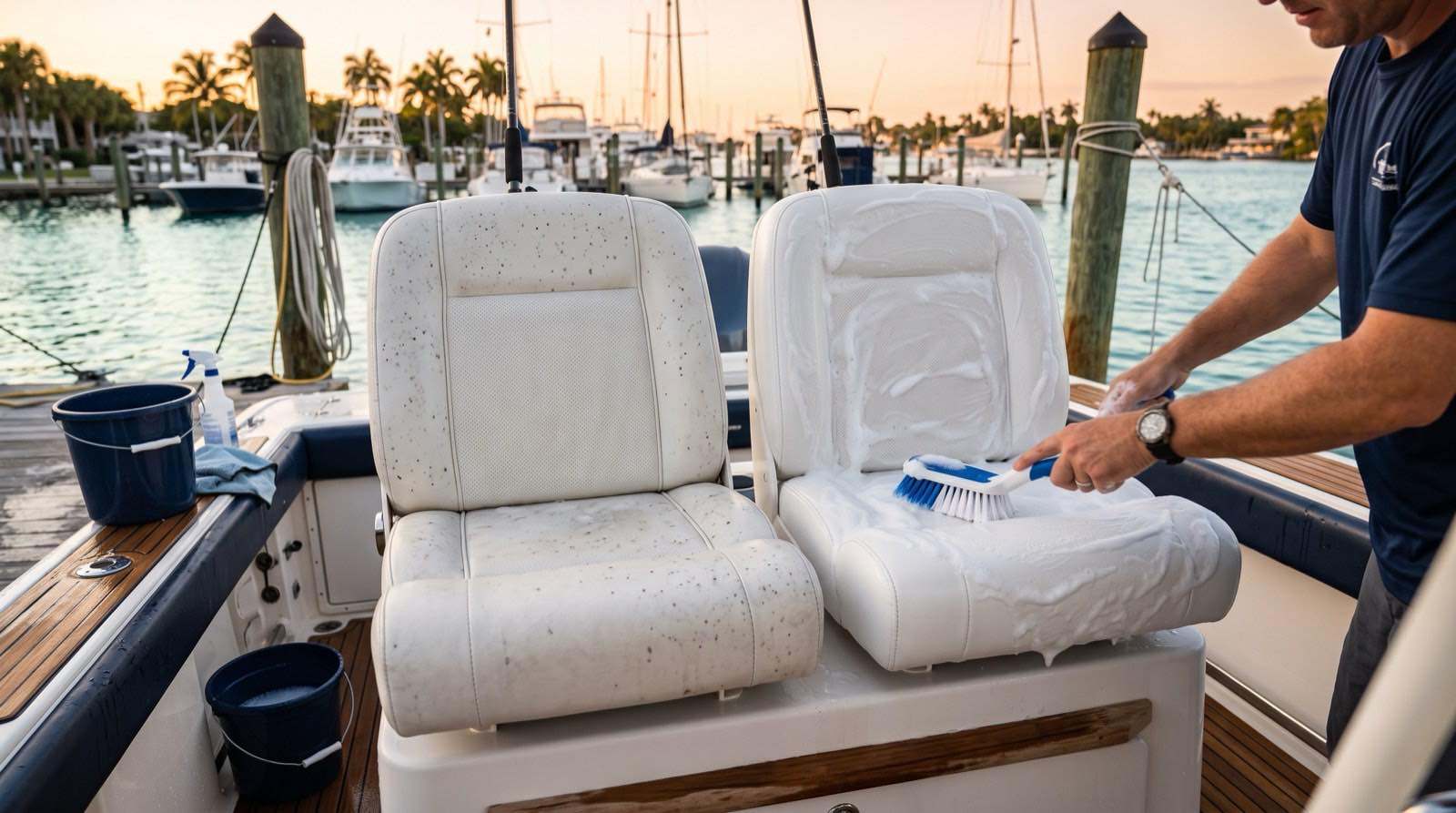
Why Florida boat seats mildew so fast
Mildew needs three things: moisture, warmth, and something organic to eat. A boat cockpit in a Jacksonville summer provides all three on schedule — humid air, 90-degree days, and a film of sunscreen, salt, body oils, and dead skin on every seat. The mildew isn't usually eating the vinyl itself; it's living on that film and on any moisture trapped in seams and under cushions. That matters, because it means the fix is as much about cleaning the food source as killing the spots you can see.
It also means covered boats aren't automatically safe. A cover that traps humidity with no airflow is a mildew greenhouse — plenty of the worst interiors we see come out from under tight covers after a month of summer storage.
Mold or mildew — and does the difference matter?
Most people use the two words interchangeably, and for cleaning a boat seat that's mostly fine. But there is a real difference, and it changes how worried you should be.
Mildew is a surface-growing fungus. On boat vinyl it shows up as the familiar scatter of small grey, black, or pinkish speckles sitting on top of the material, usually where sunscreen, body oil, and moisture have collected — seams, seat backs, the underside of cushions. It's ugly, but it's on the surface, and surface problems clean up.
Mold grows into what it's living on. On a boat that means it's got past the vinyl's topcoat and into the stitching, the backing, or — the real problem — the foam underneath. Mold on a boat seat tends to look fuzzy or raised rather than speckled, often green, blue-green, or genuinely black, and it usually comes with a musty smell that doesn't leave when the boat airs out.
The practical test is the smell and the return rate. If the spots wipe away with a proper marine vinyl cleaner and stay gone, you had mildew. If they come back within a few weeks in the same places, or the cabin still smells musty after the seats look clean, the growth is living somewhere you haven't reached — almost always the foam. Cleaning the surface of a cushion whose foam is colonized is treating the symptom; the spores are being re-seeded from inside every time it gets damp.
That distinction is also where DIY stops. Surface mildew is genuinely a weekend job with the right products, and the routine below handles it. Mold in the foam needs the cushion opened up or hot-water extraction to pull the growth out of the core — and if the foam is fully colonized and crumbling, replacing the foam is more honest than cleaning it. Either way the method below is the same first step: you can't diagnose what's underneath until the surface is properly clean.
What not to use (the vinyl-killers)
- Bleach and bleach-based sprays. Yes, they kill the mildew — and they also break down the vinyl's plasticizers and rot the polyester stitching. The seat looks great for a month, then the seams start letting go and the vinyl stiffens and cracks. Bleach damage is cumulative and irreversible.
- Magic erasers. They're micro-abrasives. They erase the stain by sanding off the vinyl's protective topcoat, which is exactly the layer that was resisting stains and UV. Everything gets dirtier faster afterward.
- Pressure washers. Drive water straight through the seams into the foam, and wet foam is the mildew problem you can't clean — it wicks back out through the stitching for months.
- Household degreasers and all-purpose cleaners. Most are far too alkaline for marine vinyl and strip the topcoat chemically instead of mechanically.
The routine that works
- Vacuum and rinse first. Get loose dirt off so you're not grinding it in.
- Marine vinyl mildew cleaner, soft brush. Spray a dedicated marine vinyl cleaner, let it dwell a minute or two, then agitate with a soft-bristle brush — soft enough that you'd use it on your forearm. Work the seams and pleats where the colonies actually live.
- Get into the stitching. An old toothbrush along seam lines pulls out what a big brush rides over. This is the difference between "cleaned" and "comes back in two weeks."
- Rinse thoroughly and towel dry. Cleaner residue left behind becomes the next food film.
- Protect — with the right product. A water-based marine vinyl protectant (303 Aerospace is the standard) adds UV protection and makes the surface harder to colonize. Skip silicone-heavy shine products; they attract dirt and make future cleaning harder.
Deep-set black spots that survive this are usually mildew that's penetrated under the topcoat or into the foam below — at that point surface cleaning can't reach it, and it's a job for extraction equipment or, worst case, reupholstery.
Keeping it from coming back
Prevention is boring and it works: rinse and towel-dry seats after salt or sweat days, crack compartments and prop cushions so air moves during storage, use a vented cover rather than a sealed one, and wipe vinyl down with protectant every few weeks in summer. If the boat lives on the water and the interior keeps getting away from you, that's exactly what our interior detailing and mold removal service exists for (pontoon owners: your acres of vinyl furniture are the worst-case scenario here — our pontoon detailing covers all of it) — and a recurring maintenance plan includes the vinyl wipe-downs that stop colonies from ever establishing. Canvas and enclosures mildew by the same logic; our canvas & isinglass service handles those.